Gaumukh Tapovan Trek
8 Days / 7 Nights through the Western Ghats. Transport, meals and accommodation included. ₹15,999/person.
₹15,999/ person
Trek at a Glance
Duration
8 Days / 7 Nights
Overview
null
Itinerary
The following detailed itinerary provides a day-by-day breakdown of your exciting Gaumukh Tapovan trek. From your arrival to the moment you return home, we've outlined your activities and experiences to make the most of your trek. Let's dive into the specifics.
Drive from Dehradun to Gangotri (3415m)
On the first day of the Gaumukh Tapovan trek, you will depart from Dehradun for Gangotri.
The travel will begin early (if transportation is arranged with us, or else you will arrive immediately in Gangotri), and it will be a 241-kilometer journey.
The entire drive will take 8 hours, excluding mountains, and will begin at Mussoorie, a well-known hill station surrounded by the Shivalik Range.
Later, the attractions will be Dhanulti and Chamba, followed by Uttarkashi. Uttarkashi, the region of gods, is located on the banks of the river Bhagirathi.
Along the journey, you will visit various temples, as well as the sights of Harshil village.
Harshil Hamlet is well-known for its apple orchards, which are beneficial to the eyes.
After a long journey, you will arrive in Gangotri, which is located on the Bhagirathi River bank, where you may wander to the local market and admire the beauty of the surrounding mountains.
There will be decent network access, so you will be able to snap and upload photos quickly.
Overnight camp stay with dinner
Gangotri (3,048 m) to Chirbasa (3,600 m)
Today is our first day on the actual journey. We begin early after an early breakfast. We'll be trekking towards Gaumukh, the Gangotri glacier's snout.
Our objective for today is Chirbasa, which is at an altitude of 3,600 metres and means "home of pine" in the local language—no points for guessing what kind of trees you might see on the way to Chirbasa, which will take us 4 hours to reach.
The entire journey up to Chirbasa is beside the roaring Bhaigrathi River, whose refreshing energy is sure to keep the spring in your step all the way through.
Overnight camp stay with dinner
Chirbasa to Bhojbasa (3,800 m)
Your hike begins at Chirbasa, the campsite where you spent the previous night. Chirbasa is recognised for its scenic splendour, which includes views of the surrounding Himalayan peaks and alpine meadows.
Beyond Chirbasa, the environment becomes quite arid and barren. Many trekkers refer to it as Arctic Tundra.
We continue our trip from Chirbasa to Bhojwassa, passing through dense forest the entire way. A 5-mile trip takes 3–4 hours.
In Bhojbasa, there is a modest shrine and a possible camping site beside the river.
In the afternoon, we have free time to explore the area and watch the spectacular sunset above Bhagirathi's peaks.
Overnight camp stay with dinner
Bhojbasa to Gaumukh (3,900 m) to Tapovan (4,335 m)
Today's the big day. We wake up to the magnificent view of the Bhagirathi range of peaks and set out for our next campground after an early breakfast.
We will be crossing the glacier's snout, which we had glimpses of on our way yesterday.
We shall travel alongside our friend, the River Bhagirathi, till we reach Gomukh.
Gaumukh, which translates to "cow's mouth," was dubbed thus by ancient sages because of its appearance.
Gaumukh is known as the Ganga's source and the starting point for its long trip through the various locations through which it passes.
We spend some time exploring the region around Gomukh before continuing on to Tapovan-one of the finest high-altitude alpine meadows in the area.
The trail from Gaumukh onwards is one on moraine-rich glaciers.
The view of the surrounding peaks starts to get wider and wider as the trail from Gaumukh to Tapovan gets steeper with every step forward and as we climb, the view of the surrounding peaks becomes clearer.
They appear to be just a stone's throw away. It is also a little wonder why Sadhus and saints choose this spot for extended meditation during the long summer months.
Overnight camp stay with dinner
Tapovan (4,463 m) rest day
This day is free for us to acclimatise, rest and enjoy the amazing snow-capped peaks, vegetation, fauna and mountain scenery.
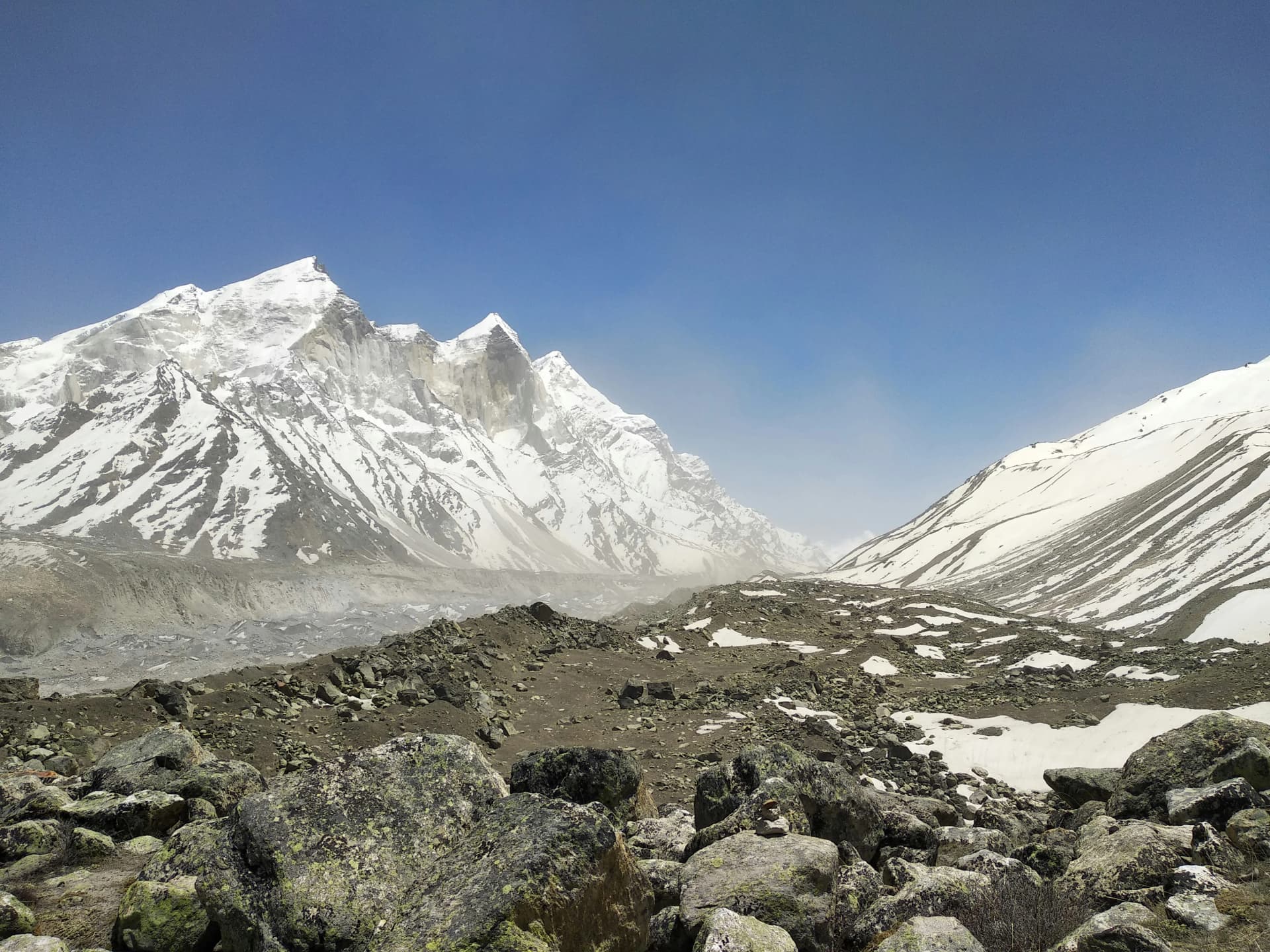
Some of the world's best mountaineers visit this region. The Shivling mountain towers in front of us.
Meru is located behind Shivling and to the right. Sumeru is located somewhat to the left of Shivling.
The Bhagirathi peaks are visible farther to the left. Bhagirathi III, Meru (Central Peak), and Sumeru contain some of the most difficult climbing routes in the world.
We can visit the Meru Glacier and then return to our campground.
apovan to Bhojbasa
The trail that led to Bhojbasa camp is used to return to Gangotri. It's a very gradual downhill that takes much less time to complete than the ascent.
Yes, you must once again navigate the glacier's rugged landscape and moraines. Descending, they say, is more difficult than rising; you'll realise this as you navigate the boulders.
Keep your step steady and move gradually. Try to recall the memories as you retrace your steps.
Walk by the Bhagirathi River. The trip to Bhojbasa will take 5–6 hours.
Overnight camp stay at Bhojbasa with dinner
Bhojbasa to Gangotri
On the fifth day of the Gaumukh trip, you will return to Gangotri from Bhojbasa after completing the entire journey.
It is preferable to get up early so that you can enjoy the last few moments in and connect with other peaks.
Later, eat breakfast and prepare to hike back to Gangotri from Bhojbasa; bring plenty of water bottles because there will be no water sources in between. You must cross the glacier's rugged terrain and moraines.
You will come across sacred mountains that shine brightly in front of you.
You will notice that Mt. Shivling appears to be made of magical boulders, so proceed slowly and carefully.
Overnight stay at Gangotri
Gangotri to Dehradun drive
The sixth day of the Gaumukh trek will be the final day, as you travel back to Dehradun from Gangotri, take one last look at the towering mountains with a sip of tea, and say goodbye to the mountains.
The journey from Gangotri to Dehradun takes 8 hours.
Inclusions & Exclusions
What's Included
- Two nights' accommodation in Gangotri in a double or triple sharing room.
- Three nights' accommodation in trekking tents on a triple-sharing basis.
- During the trek, there will be one certified trekking guide present.
- Trekking Crew (Cooks and Helpers).
- All trekking and camping permits and permissions.
- The basic Indian vegetarian meals will begin with dinner on Day 1 and end with breakfast on Day 7. There will be 3 meals every day.
- Health & Safety: First Aid Box, Oxygen Cylinders, Stretchers, Oxi meters, BP Machines, health.
What's Excluded
- GST of 5% is mandatory on the invoice amount.
- Any type of travel or health insurance
- Any meals, snacks, or beverages consumed during the trip.
- Any cost for airfare or train travel.
- Any type of medical expense.
- Accommodation and meals in Dehradun (subject to additional costs).
- Any tips, laundry, phone calls, spirits, mineral water, camera rental or other personal costs.
- Any additional fees or charges are not shown in the cost-included section.
- Backpack offloading charges: the backpack should weigh no more than 9 kg.
- Suitcases, strollers, and duffel bags will not be allowed.
What to Expect
One of the trek's highlights is arriving at Gaumukh, where hikers can see the awe-inspiring sight of the glacier's terminus and the milky-white waters of the Bhagirathi River bursting out of it. From Gomukh, the trail climbs steeply towards Tapovan, providing panoramic views of the surrounding peaks and glaciers.
Accommodations
Twin / Triple Sharing Camping tents or Dorms stay during the trek.
Backpackers United
Backpackers United will accompany the entire trip, and local backpackers will join along the way.
Starting from
Local Expert
Leave planning to our Bangalore team. 50,000+ treks. 7 years.
Call us anytime
+91 83108 22183
Frequently Asked Questions
10 questionsHow can I confirm my booking?
You can directly reserve your slots by booking on the website, please ensure proper dates are selected before confirming your booking.
Is it safe for female travellers?
Safety and Security Guidelines are followed at all times, and it is our topmost priority. We have certified trek leads (male and female) accompanying the participants at all times, and our stay follows well-rounded safety measures.
What payment options do I have?
We have multiple payment options on the website that you can refer to.
Is the Gaumukh Tapovan Trek suitable for beginners?
Gaumukh Tapovan is graded as a moderate-to-difficult trek with an altitude of 14,600 ft. A beginner can opt for Gaumukh Tapovan with decent fitness. However, one can start exercising and walking prior to the first 2 weeks of the trek for smooth trekking during it.
Where is Gaumukh Tapovan situated?
The trek starts from Dehradun and drives till Gangotri, situated in Uttarakhand, from where the actual trek starts.
What is the physical fitness requirement for Gaumukh Tapovan?
Gaumukh Tapovan is a moderate-to-difficult trek that offers adventure as well as fun. Hence, a person who is physically and mentally fit can prefer this trek. However, prior to 2 weeks of trekking, one can start walking for 30 minutes daily and speed up later on to get good fitness for the trek.
What is the best time to do Gaumukh Tapovan?
The best season for Gaumukh Tapovan is between May and June and mid-August and October.
What type of equipment is provided during trekking?
All the common gear, like tents, sleeping bags, mattresses, etc., is provided. All the technical climbing equipment, like gaiters, helmets, and micro-spikes (as required), is also provided to you. Safety equipment used for rescue is carried by our trek leaders.
Is it safe to do the Gaumukh Tapovan Trek?
Yes, the Gaumukh Tapovan is considered to be safe, but with any trek, there are inherent risks involved. It is important to follow Trek leader instructions, safety guidelines, stay hydrated, and wear proper clothing, footwear.
Are there any permits required for the trek?
Yes, trekkers need to obtain permits from the forest department for the trek, which is included in the package. Kindly refer to our inclusions and exclusions section.
Transparent cancellation policy
Good to know
- Once a flight or train is booked, it is non-refundable.
- Minimum 8 trekkers required for group departures. If the group falls below 8, you'll be offered an alternative.
- In case of weather, strikes or government restrictions, trips may be modified. Cash refunds aren't issued in such cases.
- 5% GST + 3% booking fee is non-refundable on all bookings.
| Days before | Charge | Refund |
|---|---|---|
| 15–30 days | 25% | 75% refunded |
| 7–15 days | 50% | 50% refunded |
| 3–7 days | 75% | 25% refunded |
| 0–3 days | 100% | No refund |