Savandurga Hill Trek from Bangalore (2026) – Price, Itinerary & Complete Guide
Plan your Savandurga Hill Trek from Bangalore in 2026. One of Asia's largest monolith rocks at 1,226 m with stunning views, ancient temples, and scenic forest trails just 60 km away.
₹1,999
₹1,499/ person
Trek at a Glance
Duration
1 Day
Max Altitude
1,226 m
Distance
5 km
Pickup → Drop
Bangalore → Bangalore
Trip Highlights
- One of Asia's largest monolithic rocks — towering 1,226 m above sea level
- Ancient Veerabhadreshwara and Kaadu Malleshwara temples at the summit
- Thrilling rock face scramble with fixed iron chains
- Dense dry deciduous forest trail through the base
- Panoramic views of Manchanabele reservoir and Bangalore plains
- Night departure — trek without losing a work day
- Expert Backpackers United guides throughout
Savandurga Hill Trek from Bangalore – Distance, Difficulty, Itinerary & Booking Guide
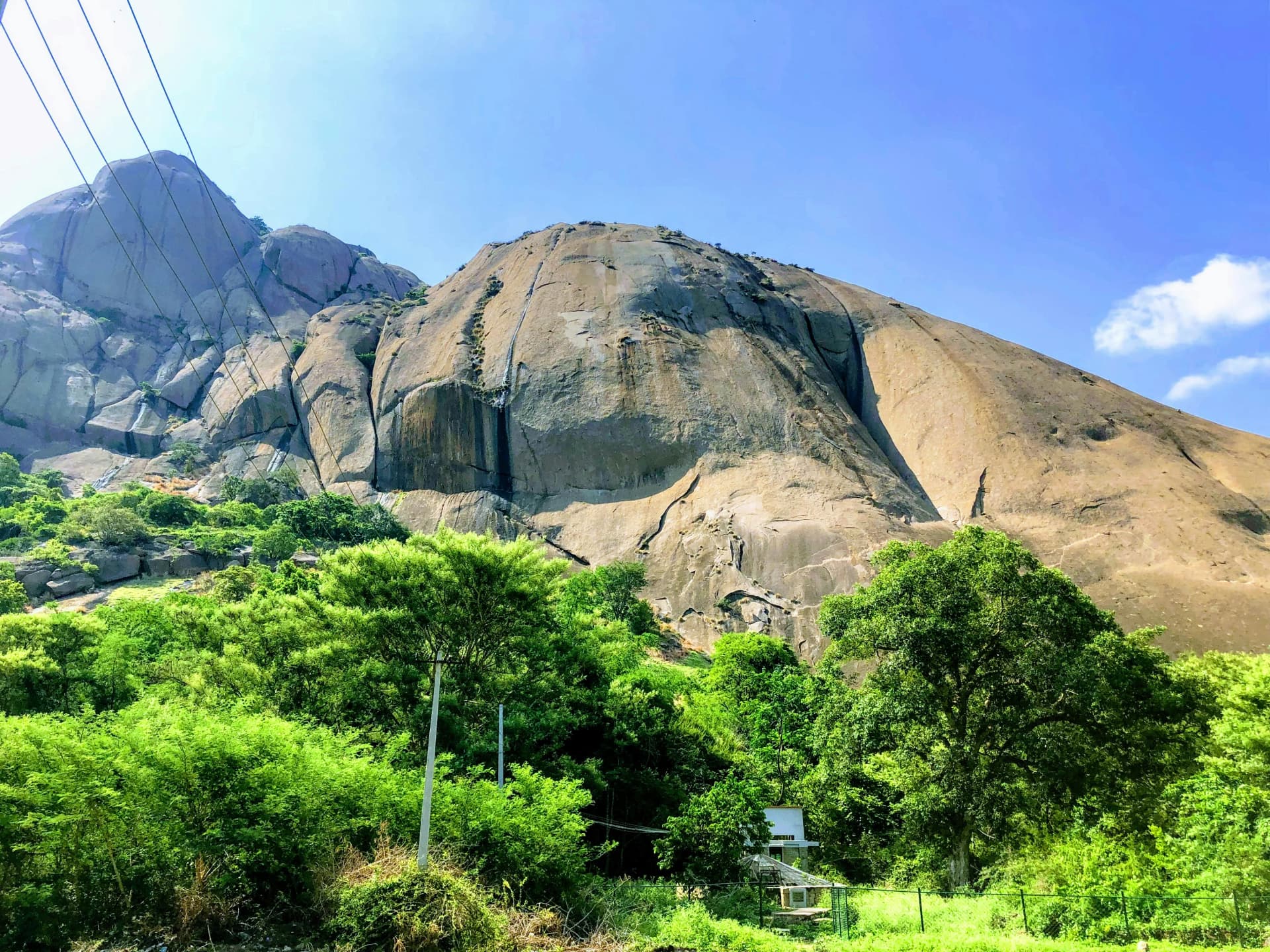
Savandurga, standing 1,226 metres above sea level and approximately 60 km from Bangalore, is one of the largest monolithic rocks in Asia. This ancient granite giant in the Ramanagara district has been drawing trekkers, rock climbers, pilgrims, and history enthusiasts for decades. The trek combines a scenic forest walk with an exhilarating scramble up steep granite rock faces, rewarding those who reach the top with sweeping views across the Deccan plateau and the shimmering Manchanabele reservoir.
About Savandurga
Savandurga translates to 'fort of Savana,' a reference to the fierce deity Veerabhadra enshrined at its summit. The hill comprises two main peaks — Karigudda (the black hill) and Biligudda (the white hill) — together forming one of the largest single-rock formations in the Indian subcontinent. The black granite surface absorbs sunlight dramatically, giving the rock its characteristically dark and imposing appearance, especially in the afternoon light.
Trek Difficulty and Terrain
Savandurga is rated moderate to difficult, primarily due to the steep granite rock face that forms the central challenge of the trek. The initial forest trail is gentle and well-shaded, suitable for most fitness levels. The rock scramble, however, requires confidence on steep surfaces and a willingness to use fixed iron chains and ropes. Good grip footwear — ideally trail running shoes or trekking boots — makes a significant difference on the smooth granite.
Historical and Mythological Significance
Savandurga's strategic position made it a coveted military asset for centuries. Hyder Ali and his son Tipu Sultan, the rulers of Mysore, used the hill as a fortress and reportedly stored arms and ammunition in caves within the rock. The natural height and sheer faces made it nearly impregnable to conventional assault. Today, remnants of this military past are visible in the form of ancient stonework near the base.
Summit Temples
Two ancient temples await trekkers who make it to the top of Savandurga. The Veerabhadreshwara Temple, dedicated to a fierce form of Lord Shiva, is the older and more significant of the two. The Kaadu Malleshwara Temple sits nearby and attracts dedicated pilgrims, particularly on auspicious days. Both temples are actively maintained and are considered sacred by local communities — trekkers are welcome to visit with appropriate respect.
Views from the Summit
The summit of Savandurga offers 360-degree views across Karnataka's Deccan plateau. The Manchanabele reservoir glitters in the distance, and on exceptionally clear days, the Bangalore skyline is visible on the eastern horizon. The surrounding landscape is dotted with smaller hills, rural villages, and patches of reserved forest — a stark and beautiful contrast to the urban sprawl of the city below.
Booking Your Savandurga Trek
Backpackers United runs regular Savandurga treks from Bangalore on weekends throughout the year, with night departures ensuring you lose no work day. Pickups are available from Indiranagar, Domlur, Marathahalli, and Hebbal. All logistics including transport, experienced guides, breakfast, and forest permits are included in the package. Slots fill up quickly during the October-February season — early booking is recommended.
Itinerary
The Savandurga Hill Trek operates as a comfortable overnight trip from Bangalore, with an evening pickup allowing you to return home after a full summit experience without taking time off work. The itinerary is designed to reach the trailhead at the ideal pre-dawn hour, completing the ascent in cooler morning temperatures before Savandurga's granite begins to absorb the day's heat. Breakfast is served near the summit, making the effort even more rewarding.
Savandurga Hill Trek – Altitude: 1,226 m | Distance: 5 km
Indiranagar 9:00 PM – Karachi Bakery
Domlur 9:15 PM – Union Bank
Marathahalli 9:45 PM – Kalamandir
Hebbal 10:15 PM – Esteem Mall
Board your comfortable vehicle at your chosen pickup point as Bangalore winds down for the evening. The drive to Savandurga takes approximately 1.5–2 hours, arriving at the base village in the early hours of the morning.
After a brief rest and gear check at the base, your Backpackers United guide will lead the group onto the trail under the beam of headlamps. The initial forest section is cool and atmospheric in the pre-dawn darkness, with the sounds of the Karnataka countryside surrounding you. As dawn begins to break, the granite dome of Savandurga emerges dramatically against the lightening sky.
The rock face ascent begins as morning light arrives — perfect timing to see the granite glow in the early sun while temperatures remain cool and manageable. Fixed iron chains assist on the steepest sections. The final push to the summit rewards you with sweeping 360-degree views across the Deccan plateau, the Manchanabele reservoir shimmering in the distance.
Breakfast is served at or near the summit — a well-earned meal with arguably the best dining view within driving distance of Bangalore. After exploring the ancient Veerabhadreshwara and Kaadu Malleshwara temples, begin the descent back to the base village. The return drive departs mid-morning, dropping you back at your Bangalore pickup points by early afternoon.
Best Time to Visit
Savandurga can be visited year-round, but the experience varies significantly with the seasons. The post-monsoon and winter months offer the most rewarding trek with clear skies and comfortable temperatures, while the summer heat makes early morning starts essential. Each season brings its own character to this monolithic giant near Bangalore.
Oct – Feb
Recommended
The October to February window is the best time to trek Savandurga. Post-monsoon greenery transforms the hillside, and cool winter temperatures ranging from 12°C to 25°C make the steep rock ascent manageable and enjoyable. Clear skies offer spectacular panoramic views from the summit, and the ancient Veerabhadreshwara temple looks its most picturesque against the lush backdrop.
Jun – Sep
Monsoon
The monsoon season brings dramatic clouds and mist swirling around Savandurga's granite flanks, making for moody and atmospheric photographs. However, the wet rock surface becomes extremely slippery and dangerous — most operators suspend treks during peak monsoon months. If you choose to visit in early June or late September, exercise extreme caution and only go with experienced guides.
Mar – May
Summer
Summer treks at Savandurga are challenging due to temperatures that can exceed 38°C by midday. The exposed granite rock absorbs heat intensely, making ascents during late morning extremely uncomfortable. If visiting in summer, depart well before sunrise and aim to complete the summit push by 9 AM. Carry double the usual water supply and watch for signs of heat exhaustion.
Regardless of season, always check the weather forecast before heading to Savandurga. Sudden afternoon thunderstorms can occur from March through September, and being on exposed granite during lightning is extremely dangerous. The Karnataka Forest Department periodically closes the trek after heavy rainfall — always verify access conditions before your visit.
Trek Route Breakdown
Savandurga's trekking route navigates through dense scrub forest before attacking the monolithic granite face directly. The trail is a mix of beaten earth paths, scrambling over smooth rock, and using iron chains on the steeper sections. Total return trek covers approximately 5 km with an elevation gain of around 450 metres from the base village.
Base Village to Rock Face
2 km approx 1 hrThe initial stretch from the base village winds through shaded forest and gentle inclines. The path is well-marked and relatively straightforward, passing through dry deciduous woodland with views of the granite dome appearing gradually above the treeline. This section serves as a warm-up before the more demanding rock ascent ahead.
Rock Face Traverse
1.5 km approx 1 hrThe most technically demanding section of the Savandurga trek, the Rock Face Traverse involves direct scrambling up smooth granite surfaces with inclinations of 45 to 60 degrees in places. Iron chains and ropes are fixed at key points to assist climbers. Focus, careful footwork, and good grip footwear are essential here — this is where most trekkers feel the adrenaline kick in.
Upper Slope to Summit
1.5 km approx 45 minFrom the upper rock band, the gradient eases slightly as you make the final push to the summit. The views expand dramatically with each step — on clear days you can see the Manchanabele reservoir and the rolling plains stretching towards Bangalore. The summit area features the ancient Veerabhadreshwara and Kaadu Malleshwara temples, making the effort doubly rewarding.
Inclusions & Exclusions
What's Included
- Comfortable AC vehicle pickup and drop from Bangalore
- Experienced certified trek leader
- Breakfast at or near the summit
- Fixed rope and chain assists on rock face sections
- First aid kit and emergency support
- Karnataka Forest Department entry permit fees
- Travel insurance coverage during the trek
What's Excluded
- Personal trekking gear — shoes, backpack, clothing
- Personal snacks and water beyond what is provided
- Any expenses of a personal nature
- Anything not explicitly mentioned in the inclusions
What to Expect
Trekking with Backpackers United at Savandurga is designed as a premium-comfort day experience with all logistics handled end-to-end. From the moment you board the vehicle in Bangalore, you're in the hands of a team that has done this route dozens of times and knows exactly how to make the day both safe and memorable. The group size is kept intentionally small to ensure personal attention and a genuine adventure feel rather than a crowded tourist excursion.
Every aspect of the experience is planned with your comfort in mind — comfortable AC vehicles for the road journey, an experienced guide who paces the trek to the group's fitness level, fresh breakfast served at the summit area, and a smooth return that has you back in Bangalore by early afternoon. For many trekkers, the Savandurga trip with Backpackers United becomes the gateway to a longer adventure journey.
Backpackers United
Your Savandurga trek is led by senior Backpackers United trek leaders with multiple successful summits under their belt. Every guide is trained in first aid and wilderness safety protocols, knows the terrain intimately, and is equipped with the knowledge to manage the group safely through the steep rock face sections. Our guides are passionate storytellers who bring alive the mythology, geology, and ecology of Savandurga, making the experience richer than just a physical challenge.
Safety on the rock face is the guide's primary responsibility, and Backpackers United trek leaders are specifically trained for the unique challenges of granite scrambling — managing rope assists, monitoring group spacing, and identifying trekkers who may need additional support. You are in experienced, confident hands from the first step of the trail to the last.
Things to Carry
Trekking shoes: Grippy, closed-toe footwear is essential for the granite rock sections — regular sneakers or sandals are not safe.
Water (2 litres minimum): The rock face can get hot and dehydration risk is high, especially in summer months.
Layered clothing: Nights and early mornings near Savandurga can be cool — carry a light jacket or fleece for the vehicle ride.
Snacks: Energy bars, nuts, or dry fruits for sustained energy during the climb.
Torch or headlamp: You will start the trek in darkness — a reliable headlamp with fresh batteries is non-negotiable.
Sunscreen and cap: The granite rock provides no shade from mid-morning onwards.
Light daypack: Keep both hands free for the rock face scramble — do not carry a shoulder bag.
Rain jacket (monsoon months): Pack a compact rain jacket if visiting between June and September.
What NOT to carry
Heavy backpacks, glass bottles, valuables, or non-biodegradable waste. The Savandurga forest is a protected area — carry out everything you carry in.
Starting from
₹1,999
Local Expert
Leave planning to our Bangalore team. 50,000+ treks. 7 years.
Call us anytime
+91 83108 22183
Frequently Asked Questions
15 questionsWhat is Savandurga Hill and why is it famous?
Savandurga is a massive granite monolith in Ramanagara district, Karnataka, approximately 60 km from Bangalore. Standing at 1,226 metres above sea level, it is one of the largest monolithic rocks in Asia. It is famous for its dramatic steep rock face, ancient temples of Veerabhadreshwara and Kaadu Malleshwara at the summit, its historical connection to Hyder Ali and Tipu Sultan, and as a premier rock climbing destination in South India.
How far is Savandurga from Bangalore?
Savandurga is approximately 60 km from central Bangalore via Magadi Road (NH 75). The drive typically takes 1.5 to 2 hours depending on traffic. Backpackers United picks up trekkers from Indiranagar, Domlur, Marathahalli, and Hebbal — making it easy to join without arranging private transport to the trailhead.
What is the altitude of Savandurga?
Savandurga reaches an altitude of 1,226 metres (4,024 feet) above sea level. The base village sits at approximately 780 metres, meaning trekkers gain around 450 metres of elevation during the ascent. Despite its modest altitude, the steep granite rock face makes the climb feel significantly more challenging and rewarding than the numbers suggest.
What is the difficulty level of the Savandurga trek?
The Savandurga trek is rated moderate to difficult. The initial forest trail from the base village is gentle and manageable for most fitness levels. The challenge lies in the steep granite rock face in the middle section, requiring scrambling at 45–60 degree angles with fixed iron chain assists. Good physical fitness, confidence on steep surfaces, and proper grip footwear are essential.
Is the Savandurga trek suitable for beginners?
Savandurga is not recommended as a first trek for complete beginners due to the steep granite rock sections. However, reasonably fit individuals who are comfortable with heights can attempt it with proper guidance. Children below 10 years and those with knee or joint problems should avoid the steep rock face. Backpackers United guides provide full support throughout the ascent.
What is the best time to visit Savandurga for trekking?
The best time to trek Savandurga is October to February. Post-monsoon greenery and cool winter temperatures (12°C–25°C) make the ascent comfortable and the views spectacular. March to May is trekable but hot — very early starts are essential. June to August (peak monsoon) is not recommended as the granite rock becomes extremely slippery and dangerous.
How long does it take to complete the Savandurga trek?
The complete Savandurga trek — ascent, summit time, and descent — typically takes 3 to 4 hours. The ascent from the base village to the summit takes approximately 1.5 to 2 hours, and the descent around 1 to 1.5 hours. Total time at the trailhead including breakfast and temple visit is generally 5 to 6 hours before the return drive to Bangalore.
How do I reach Savandurga from Bangalore?
Savandurga is reached via Magadi Road (NH 75) from Bangalore, turning off towards Manchanabele village — approximately 60 km from the city centre. No direct public transport runs to the base village. Most visitors join organised group treks with operators like Backpackers United, which provides transport from four Bangalore pickup points and handles all logistics including forest permits.
What are the two peaks of Savandurga — Karigudda and Biligudda?
Savandurga comprises two distinct granite peaks: Karigudda (meaning "black hill" in Kannada) and Biligudda (meaning "white hill"). Karigudda is the higher, more prominent trekking peak, featuring the main rock face and the ancient temples. The difference in colour comes from variations in mineral composition — Karigudda's darker granite absorbs sunlight intensely, making it significantly hotter to the touch on summer afternoons.
What temples are located at the summit of Savandurga?
Two ancient temples stand at the summit of Savandurga. The Veerabhadreshwara Temple is dedicated to Veerabhadra, a fierce form of Lord Shiva, and is the older and more significant of the two. The Kaadu Malleshwara Temple is also dedicated to Lord Shiva in his benevolent form. Both temples are actively worshipped by local communities — trekkers are welcome to visit with respect for the religious sanctity of the site.
What is the mythological and historical significance of Savandurga?
Savandurga holds deep religious and historical importance. Mythologically, it is associated with Veerabhadra — a fierce manifestation of Lord Shiva — and has been a site of active worship for centuries. Historically, Hyder Ali and Tipu Sultan used the hill as a natural fortress due to its commanding height and sheer rock faces. Tipu Sultan reportedly stored arms and ammunition in caves within the rock. The name "Savandurga" derives from "Savana" (the deity) and "Durga" (fort or stronghold).
Is Savandurga a good destination for rock climbing?
Yes — Savandurga is one of the premier rock climbing destinations in South India. The massive granite face offers routes for all levels, from beginner-friendly slabs to technical multi-pitch climbs graded up to 6b+ in the French grading system. Climbers from across India and internationally visit regularly. Note that Backpackers United's trek uses the standard trekking route with fixed chain assists — dedicated climbing trips require separate arrangements with certified instructors and proper equipment.
What should I carry for the Savandurga trek?
Essential items include: trekking or trail shoes with good grip (mandatory for the rock face), at least 2 litres of water, a reliable headlamp with fresh batteries (trek starts before dawn), a light daypack to keep both hands free on the rock face, energy snacks, a light jacket or fleece for the early morning chill, sunscreen and a cap for the exposed summit area, and a compact rain jacket during June–September. Avoid heavy backpacks, glass bottles, or valuables.
Is the Savandurga trek safe for solo trekkers and women?
The Savandurga trek is safe for women trekkers and solo travellers when undertaken with a reputable organised group. Backpackers United maintains small group sizes with experienced certified guides, and group composition is typically diverse. The night departure and early return format means trekkers are never alone at the trailhead. Solo trekking without a guide is not recommended due to the steep rock sections and limited mobile connectivity near the summit.
What is the entry fee for the Savandurga trek?
The Karnataka Forest Department charges a nominal entry fee to access the Savandurga reserve forest — typically ₹20–50 per person, subject to revision. This fee is included in the Backpackers United trek package price. Photography and videography permits may be required separately for commercial shoots. The entire hill is a protected reserve — littering, campfires, and straying from marked trails are strictly prohibited.
Transparent cancellation policy
Good to know
- Once a flight or train is booked, it is non-refundable.
- Minimum 8 trekkers required for group departures. If the group falls below 8, you'll be offered an alternative.
- In case of weather, strikes or government restrictions, trips may be modified. Cash refunds aren't issued in such cases.
- 5% GST + 3% booking fee is non-refundable on all bookings.
| Days before | Charge | Refund |
|---|---|---|
| 15–30 days | 25% | 75% refunded |
| 7–15 days | 50% | 50% refunded |
| 3–7 days | 75% | 25% refunded |
| 0–3 days | 100% | No refund |